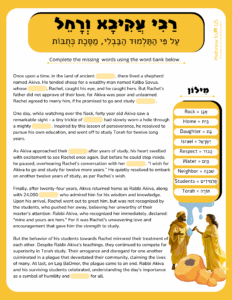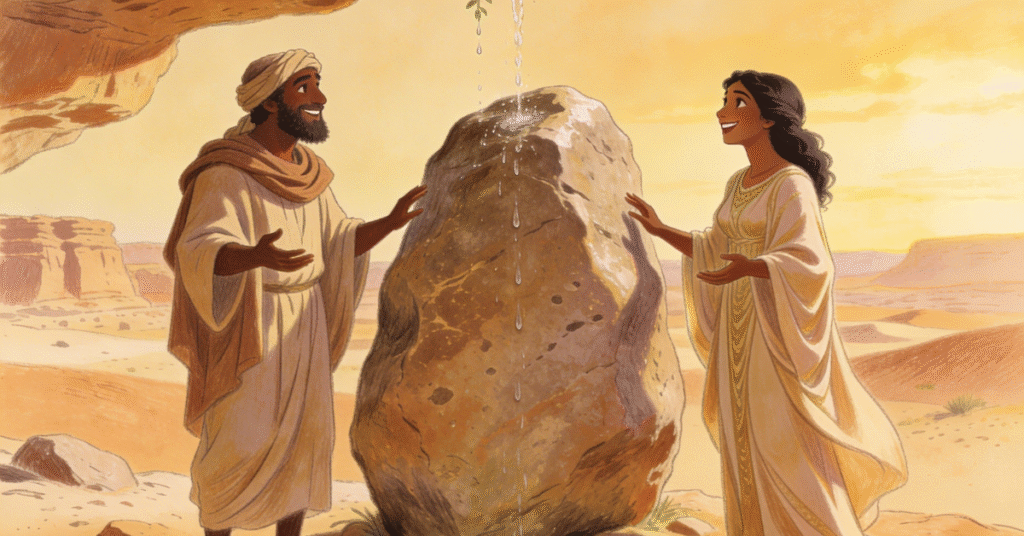
Lag BaOmer is often introduced to students through bonfires, and bows & arrows. The story of Rabbi Akiva and Rachel is the perfect anchor for a Lag BaOmer Hebrew language lesson. It weaves together core vocabulary with a narrative arc students can connect to emotionally.
Bonfires, Bows, and a Lot of Unanswered Questions
Lag BaOmer is one of the most curious holidays on the Jewish calendar, and one of the most fun to teach precisely because of that. It falls on the 33rd day of the Omer (the Hebrew letters ל”ג, lamed-gimel, add up to 33), and it’s packed with apparently unrelated events. Historically, the origins are genuinely murky. Some traditions tie it to a pause in the plague that killed Rabbi Akiva’s students. Others connect it to Bar Kokhba’s revolt against Rome. And in Kabbalistic tradition, the mystical strand of Judaism that Rabbi Shimon Bar Yochai helped shape, Lag BaOmer marks the day of his death, which his students celebrated as a spiritual revelation rather than a tragedy. In Israel, the holiday is huge: hilltop bonfires and outdoor barbecues. For diaspora kids, it often flies under the radar. That’s exactly what makes it such a rich classroom opportunity, a window into a side of Jewish life they may never have encountered.
Give Every Student a Hebrew Word and Watch What Happens
One of the best ways to bring this story alive is to get students on their feet. After reading the fill-in-the-blank passage, have students work in small groups to reenact the story of Rachel and Akiva as a short skit or improv scene. Assign each student one Hebrew word from the worksheet’s word bank, they must use it somewhere in the performance. It doesn’t have to be perfect. A student playing Rachel can hold up a sign with תורה and announce dramatically that Torah study is the condition of marriage. A student playing Akiva can crouch by an imaginary rock and talk about מים, water. The constraint of having to use their word forces genuine engagement with the vocabulary in a way no worksheet alone can achieve, and the improv energy makes the words stick.
Cursive Hebrew Doesn’t Have to Be Scary
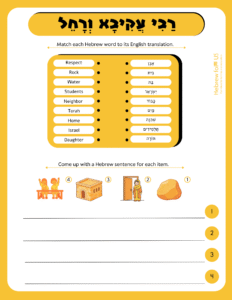
For the sentence-writing section of the worksheet, encourage students to write their Hebrew sentences in script (cursive Hebrew) rather than block print. Script is closer to how Hebrew is actually written in everyday life in Israel, and practicing it builds fluency. That said, script can feel daunting, so offer a practical scaffold: students who are struggling can choose just one sentence to write in script and complete the rest in block letters. Even one sentence in script is meaningful practice, and giving students agency over which sentence they tackle removes the anxiety that can shut down a reluctant learner. Post a Hebrew script alphabet chart on the board or include one in the handout so students have a reference as they work.