
Learning a new language can be challenging, but with the right tools, it can be an enjoyable and rewarding experience. Fortunately, there are several Hebrew learning apps available that offer different features and teaching methods. In this article, we will compare five of the most popular Hebrew learning apps: Duolingo, Rosetta Stone, Memrise, Mondly, and Drops. Contrary to popular belief – Babbel does NOT offer a Hebrew course for now. Rest assured that we will keep you informed should there be any updates!
| App | Pricing | Kid Friendly? | App Rating |
 |
Free with some paid features | Game-like experience | App Store: 4.7
Google Play: 4.5 |
 |
$15/month or $9.17/month with a yearly subscription | Structured lessons geared towards adults | App Store: 4.8
Google Play: 4.7 |
 |
Free with limited features. $8.49/month, $59.66/year, $119.99/lifetime | Lesson created by individuals from all over the globe | App Store: 4.8
Google Play: 4.6 |
 |
Free 7 days trial, $9.99/month, $3.99/month with yearly subscription | Game-like experience | App store: 4.8
Google Play: 4.6 |
 |
Free 7 days trial, $14.99/month or $99.99/year | Game-like experience, visual learning | App Store: 4.8
Google Play: 4.4 |
Duolingo
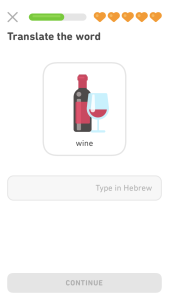 This app garnered a lot of attention in recent years, and for good reason. Perhaps the most notable advantage of Duolingo is that it is entirely free to use. While there is a family plan available for purchase, it is by no means necessary to fully utilize the app’s features. Additionally, teachers have the option to purchase a paid version for classroom use. Duolingo offers a fun and interactive experience that feels more like a game than a language lesson, with various incentives such as leaderboards and gems to keep you motivated along the way.
Duolingo’s standard language courses are also appropriate for children, with content that is appropriate for all ages. The app uses game-like elements such as animations, sound effects, and rewards to keep young learners engaged, which can be particularly appealing to younger learners. The app teaches the Hebrew Aleph-Bet methodically and strategically.
However, despite its many strengths, there are also a few downsides to using Duolingo. For instance, the app can become quite repetitive, even after you have mastered a particular skill. It’s not uncommon to find yourself repeating phrases you already know. Additionally, some of the sentences used in the app can be a bit obscure, making it less likely that you’ll actually use them in real-life conversations. Finally, the audio recordings can sound a bit robotic and unnatural, unlike a native Hebrew speaker, which may detract from the overall learning experience.
Rosetta Stone
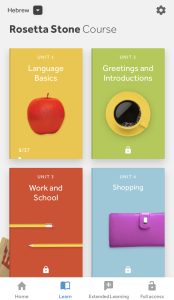 Rosetta Stone is a popular Hebrew learning app that offers both a free and paid version. The free version includes some basic lessons so you can get a taste of what the app has to offer. If you decide to commit to a full year of learning, the paid version gives you access to extended learning activities at a cost of $9.17 per month. Otherwise, it costs $15/month. If you’re really serious about learning Hebrew, there are also the Lifetime and Lifetime Plus programs, which cost $199.99 and $299.99 respectively.
While Rosetta Stone is not specifically designed for children, it can still be a useful tool for younger learners. However, it’s important to note that the software does not provide any explicit grammar or vocabulary instruction, so children may need additional help with these areas.
One potential downside of Rosetta Stone is that it uses a technique that involves words and sentences accompanied by pictures, rather than teaching each letter, consonant, and vowel separately. Some learners may find this approach repetitive and less structured than they prefer. However, the app does offer the option to read and listen to stories and allows students to record themselves with the help of the app, highlighting each word as they read along.
One thing to keep in mind when using Rosetta Stone for Hebrew is that the activities’ images are arranged from left to right, despite Hebrew being read from right to left. This can be a bit confusing at first, but most users tend to get used to it over time.
Memrise
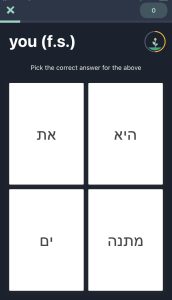 If you’re looking for a Hebrew learning app that offers a lot of flexibility, Memrise might be worth checking out. However, be prepared for a slight annoyance: you’ll need to sign up via their desktop website first before you can access the app.
One of the benefits of Memrise is that it offers a wide range of courses created by individuals, allowing you to choose the curriculum that best suits your needs. Whether you’re starting from scratch with the Hebrew alphabet or looking to dive into more advanced conversational courses, Memrise has you covered. They even offer a variety of Biblical Hebrew courses if you’re interested in expanding your religious and historical knowledge. Additionally, the app allows users to form groups to practice a language together and motivate each other.
One potential downside to Memrise is that it can be a bit overwhelming to decide which course to take. However, if you’re willing to do a bit of research, you’re sure to find a course that works for you.
If you decide to upgrade to the paid version of Memrise, you’ll get access to videos by native Hebrew speakers and the added bonus of getting rid of pesky ads.
Mondly
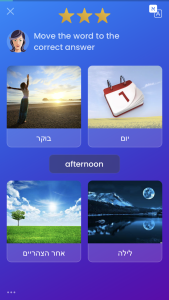 This app offers the option to learn using the Hebrew alphabet or transliteration. Every few words, the app provides a recap of the latest vocabulary that you’ve learned. There’s a 7-day trial period that provides limited access to the lessons, followed by a subscription fee of $9.99/month or $3.99/month if you choose to pay annually. However, during the trial period, you may encounter frequent ads reminding you to upgrade, which can be annoying.
One positive aspect of the app is that you have the freedom to choose which conversation topics you want to work on and can easily skip between them without having to complete one to access the others.
Drops
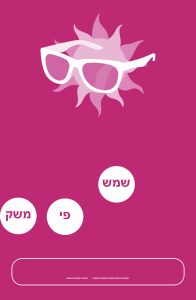 When you first download Drops, it’ll ask you about your interests, Hebrew level, and learning goals. It’s a nice touch that makes the experience feel more personal and less robotic than other language learning apps that choose topics for you. Plus, Drops uses transliteration, so if you’re eager to dive straight into conversation without learning the aleph bet, you can.
After each learning section, you can take a quiz to keep yourself engaged, and there’s a handy dictionary feature that lets you search for words you’ve learned. If you upgrade to the paid version, you’ll get access to challenges on a variety of topics.
The downside is that Drops teaches a lot of nouns in the beginner level, so it takes time to get to the sentence level. If you prefer to learn phrases in chunks rather than word by word, this may not be the best option for you, but the paid version will get you there quicker.